
 BLOG
BLOG
RTK corrections delivery method explained: how to choose the right setup?
Choosing the right RTK corrections delivery method directly affects your positioning accuracy, reliability, and field workflow. Should you install your own base station and rely on the radio? Use internet-based corrections? Or connect to a regional RTK network?
There’s no universal best option. The right setup depends on connectivity, project scale, and operational needs.
This guide explains RTK correction delivery methods through real-world scenarios using the Reach RS4 and Reach RS4 Pro receivers, helping you choose the right setup with confidence.
Key takeaways
- RTK corrections always come from a base station—the real choice is how they reach your rover: radio (LoRa or UHF), your own base over NTRIP, or a network correction service.
- No coverage, no problem: local base with LoRa or UHF keeps you fully independent of the internet, with LoRa mostly license-free and UHF built for tougher terrain and third-party radio compatibility.
- Good cellular coverage opens up NTRIP options: connect to an RTK network or Emlid Corrections for rover-only simplicity, or run your own base with Emlid Caster for more control and support for up to 10 connected rovers.
- There’s no single best method. Match your setup to internet availability, project scale, number of rovers, and how much independence you need in the field.
What are RTK corrections?
RTK (Real-Time Kinematic) is a positioning method that takes GNSS accuracy from meters down to centimeters by correcting satellite signal errors in real time.
An RTK system uses two receivers—a base and a rover. The base sits at a known location and sends its observation data to the rover. Since both receivers see the same satellites, the rover can cancel out common GNSS errors, like atmospheric delay and clock bias, and land on centimeter-level positioning in real time.
Learn more about the RTK technique in our blog post: Basics of RTK GPS and GNSS for Non-Surveyors.
Either way, corrections always originate from a base station. The real question is how those corrections reach your rover. You’ve got three options:
- Set up your own base station and transmit corrections directly to the rover via radio — LoRa or UHF.
- Set up your own base station and deliver corrections to the rover over the internet using NTRIP (Networked Transport of RTCM via Internet Protocol). This requires an NTRIP caster — a cloud service that implements the NTRIP protocol and relays data between internet-connected receivers.
- Use a dedicated corrections provider that delivers them from a network of reference stations, effectively acting as a base station, to your rover over the internet using the same NTRIP protocol. These providers go by a few names: NTRIP services, CORS services, or RTK network services. Some also offer VRS (Virtual Reference Station) services. Instead of relying on individual physical reference stations, which can sit far from your rover, VRS combines data from multiple stations to mathematically generate a virtual reference station positioned closer to you.
Radio-based corrections are pretty straightforward. The line between an NTRIP caster and an NTRIP service is where people tend to get tripped up.
The delivery method really comes down to the communication link: a direct radio connection, or the internet via NTRIP. A radio link stays fully under your control and travels with you into the field. Cellular coverage doesn’t: it shifts with location and conditions.
That said, internet-based corrections give you a longer achievable baseline, and terrain doesn’t factor in. Your setup might use two receivers—a base and a rover—or just a single rover connected to a service.
That’s why it pays to look at your actual working conditions first, then pick the setup that fits them.
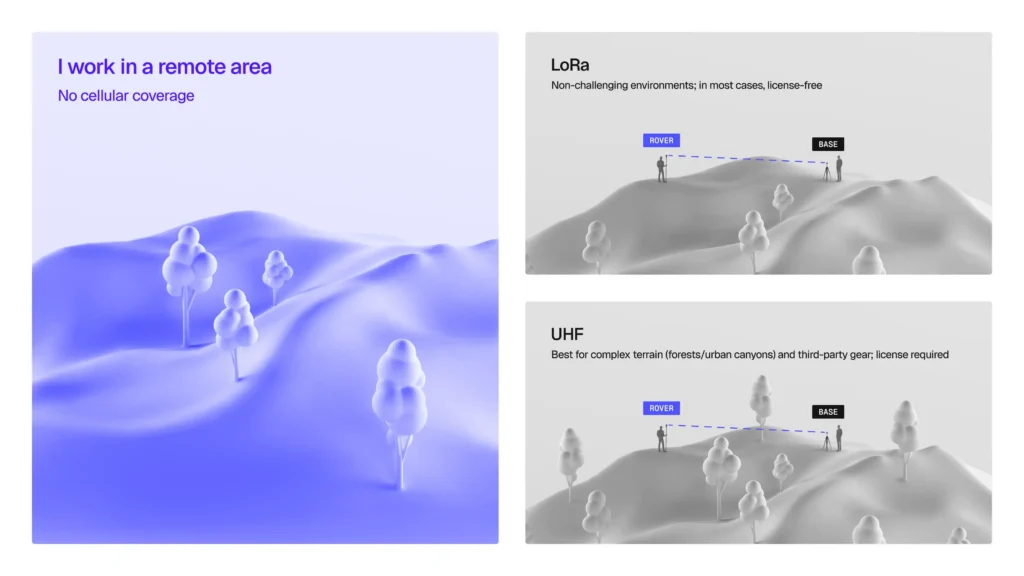
Working in remote areas without cellular coverage: LoRa vs UHF
If mobile coverage is unreliable or unavailable, your correction workflow must be fully independent. So, your recommended setup will be using your local base sending corrections to the rover via radio—LoRa or UHF. Latest Reach RS4 and Reach RS4 Pro support both two-way LoRa and UHF radios.
Advantages of LoRa setup
Although LoRa operation is subject to regional regulations, Reach RS4 and Reach RS4 Pro automatically use license-free frequencies in Emlid Flow in most regions. Where permitted, they support up to 1 W base transmit power, improving link robustness and extending baselines in challenging conditions.
Benefits of UHF setup
If you work in a challenging terrain, UHF can be a good choice where maximum signal robustness is required. Reach RS4 and Reach RS4 Pro can output corrections at up to 2W, where permitted. Plus, the UHF module filtering maintains stable radio performance even in environments with interference from other transmitters, including those located near cell towers.
In addition, the built-in UHF radio lets you mix and match Reach RS4 or Reach RS4 Pro with compatible third-party receivers. The devices support the TRIMTALK 450S protocol, enabling seamless integration into existing radio setups.
Although the receivers are shipped with region-specific limits and channel plans preconfigured in Emlid Flow to help ensure compliance, a UHF license may still be required depending on local regulations.
Work in areas with good cellular coverage: NTRIP service vs NTRIP caster vs Emlid Corrections
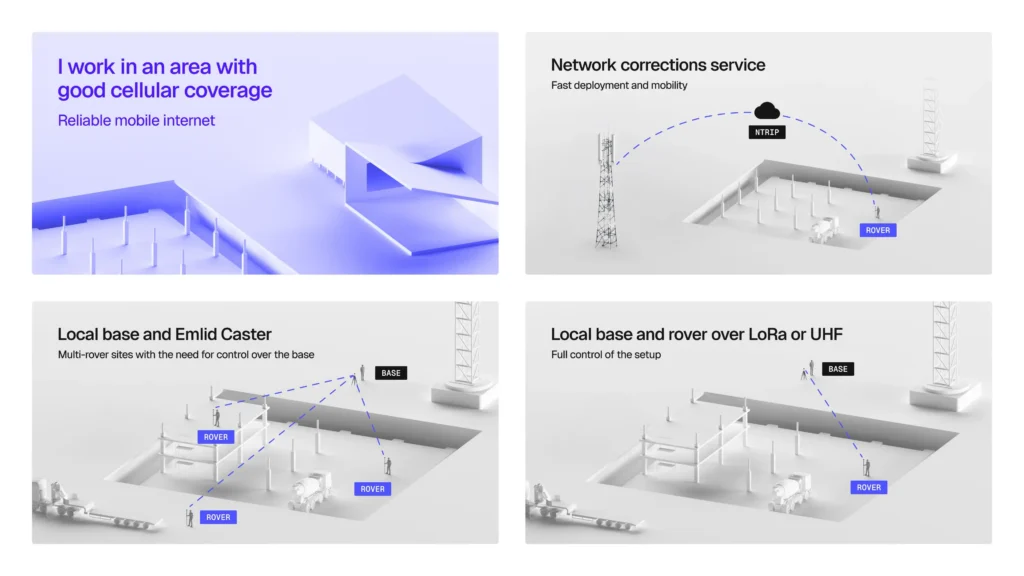
Reliable mobile internet in your working area opens up several flexible options. Which one fits comes down to how much control, scalability, and independence you need.
Opting for flexibility and mobility
If internet access is solid and the nearest reference station isn’t too far away, a network correction service is usually your simplest, most flexible option.
RTK network (NTRIP/CORS)
Corrections come via NTRIP from the closest reference station—physical or virtual, depending on the provider—so you’re not limited by line of sight to a base. This setup needs a rover connected to the internet and, in most cases, a subscription to an RTK correction service. Once you subscribe, you’ll get credentials to enter manually on the rover to connect.
It’s simple to configure—the RS4 and RS4 Pro’s built-in Bluetooth Low Energy (BLE) connectivity pairs the receiver with the Emlid Flow app, where you enter your credentials.
This workflow suits urban areas with solid mobile coverage, field teams that move between job sites, and companies trying to minimize equipment. It’s also the practical call when running your own base station wouldn’t be cost-effective for the project.
Emlid Corrections
Reach users can opt into Emlid Corrections, a network RTK correction service powered by Point One Navigation and built into compatible Reach receivers. Instead of relying on stationary reference stations near your site, the service builds a virtual reference station nearby, using data pulled from multiple physical stations. That keeps the effective baseline short, so you get consistent centimeter-level positioning across the whole coverage area.
Emlid Corrections is built into the Reach RX, RX2, RS2/RS2+, RS3, RS4, and RS4 Pro. It delivers RTK corrections without asking you to run your own base or configure an NTRIP connection by hand. Once you activate your license in Emlid Flow, the rover connects automatically to the nearest virtual reference station.
RTK is a few taps away, as long as you’re in an open area with a clear view of the sky. Every compatible Reach receiver ships with one free year of Emlid Corrections included. Check the Emlid Corrections documentation for more details.
Right now, coverage spans the US, the UK, most of continental Europe, Australia, and New Zealand, and it keeps growing.
All RTK correction services aim for centimeter-level accuracy, but what affects that accuracy differs by service type. For VRS-based services like Emlid Corrections, performance comes down mainly to whether the service covers your region—since the network builds a virtual reference station near the rover, the distance to individual physical stations doesn’t matter.
For services running off a single stationary reference station, baseline length still matters. Accuracy tends to drop as the distance between rover and station grows. In regions with dense reference networks, though, baselines usually stay short enough to hold centimeter-level accuracy across the whole coverage area.
Extending your range, or running a fleet
If you want more control over your setup, plus the flexibility of internet-based delivery, run your Reach RS4 or RS4 Pro as a base and distribute corrections through our free Emlid Caster.
The base sends corrections over the internet, and the rover picks them up over mobile data. Since nothing travels by radio, range isn’t capped by radio coverage—base and rover can sit much farther apart, as long as both have an internet connection. And you still control the base itself, which matters when you need absolute accuracy.
Emlid Caster also supports up to 10 rovers connected at once. That’s useful when multiple field crews work the same site or nearby locations and need one shared correction source—you can scale up without deploying another base station. It also means you can connect different types of equipment, like rovers and drones, to the same base. The result: full control over your correction source, consistent positioning accuracy, and a setup that scales with distributed teams.
Choosing radio anyway
Good cellular coverage doesn’t take radio off the table. The closer your base sits to the job site, the better your positioning accuracy—and when you run your own base, you know exactly where it’s installed and how stable it is.
A radio link also cuts mobile internet out of the equation entirely. No weak signal, no network congestion, no coverage gaps to interrupt the correction stream. Fewer moving parts mean fewer risks, and on projects where downtime is expensive, that matters.
A simpler, fully controlled setup means fewer failure points and more confidence in the field. If your project demands maximum reliability and zero dependence on mobile networks, a local base on LoRa or UHF sends corrections straight to the rover—no internet required. That matters most for high-precision surveying, time-sensitive construction work, or any project where a dropped correction stream costs you productivity.
Radio setups also make sense when you want full control over your correction workflow, want to skip subscription services altogether, or work somewhere mobile networks exist but choke under load.
Good coverage buys you flexibility. Radio still wins on control and self-sufficiency when reliability and independence come first.
Still choosing the radio despite good coverage
Even with good cellular coverage, you may still prefer working with your own base and radio link. The closer the base station is to your site, the better the positioning accuracy. When you control your own base, you know exactly where it is installed and can be fully confident in its stability.
A radio connection also eliminates the need for mobile internet. There are no interruptions due to weak signal, network congestion, or coverage gaps. Fewer external factors mean fewer risks, especially in projects where downtime is costly.
With a simpler, fully controlled setup, you reduce the number of potential failure points and feel more confident in the field. So, if your project requires maximum reliability and independence from mobile networks, using a local base with LoRa or UHF ensures corrections are transmitted directly from the base to the rover without relying on internet stability.
This can be critical for high-precision surveying, time-sensitive construction tasks, or projects where interruptions to correction data could affect productivity.
Radio setups are also preferred when you want full control over yourcorrection workflow, avoid subscription services, or operate in environments where mobile networks may be available but inconsistent under load.
In short, good coverage gives you flexibility—but radio remains the most controlled and self-sufficient solution when reliability and independence are priorities.
Overview
| Scenario | Equipment needed | Internet required | Range limitation* | Best for |
|---|---|---|---|---|
| Local base & LoRa | Base, rover | No | The base should be within the worksite | Remote sites, in most cases, license-free |
| Local base & UHF | Base + rover | No | The base should be within the worksite | Challenging terrain or need for compatibiliy with the third-party equipment, requires license |
| Local base & Emlid Caster | Base + rover | Yes | No need for the base on the worksite | Multi-rover sites with the need for control over the base |
| RTK network (NTRIP/CORS) | Rover only | Yes | No need for the base on the worksite | Fast deployment and mobility with confidence in the internet stability |
| Emlid Corrections | Rover only | Yes | No need for the base on the worksite | Urban projects with multi-site work or need for operations across multiple regions with reliable cellular coverage |
*RTK assumes that the base and rover operate under similar environmental conditions when correcting satellite signal errors. For Emlid Reach receivers, the recommended maximum baseline is about 8 km (5 miles) with radio corrections and up to 60 km with internet corrections. As the baseline increases, atmospheric differences may reduce accuracy, so keeping the base and rover as close as possible is recommended.
Final takeaway
There is no single best RTK correction source. The right setup depends on:
- Internet availability.
- Level of independence required.
- Site size and terrain.
- Project duration.
- Number of rovers.
Modern Emlid receivers like Reach RS4 and Reach RS4 Pro support all major RTK correction workflows, allowing you to adapt your system to real-world conditions—whether you’re working downtown, across a large construction site, or far from mobile coverage.
Choose the correction method that matches your field conditions, not just the one that seems easiest on paper.
Not sure what RTK setup is best for your workflow? Contact our team—Emlif application engineers will help you to choose the right solution for your fleet and job site.
Frequently asked questions
RTK corrections always come from a base station, but you don’t always need to deploy your own. You can use an NTRIP/CORS service provider, where the provider’s reference stations supply the corrections over the internet. In this case, you need a reliable cellular coverage.
RTK corrections can be delivered in several ways. You can transmit them directly from your own base station to the rover using radio, LoRa, or UHF, send them over the internet from your base through an NTRIP caster, or receive them from an RTK network service (NTRIP/CORS) that provides corrections from its reference station network.
Radio corrections are sent directly from the base to the rover and typically require a clear line of sight. Internet-based corrections are delivered via the NTRIP protocol over mobile data, which removes line-of-sight limitations and allows corrections to be received from network providers or distributed from a single base to multiple rovers or different types of equipment using Emlid Caster.
The main factors are internet availability, terrain, project scale, and the level of independence required. Radio corrections work best in areas without cellular coverage, while internet-based corrections offer greater flexibility and longer operational range when reliable mobile connectivity is available.
If obstacles block the radio signal between the base and rover, using internet-based corrections via NTRIP is usually the option. Since corrections are delivered over the internet, they are not affected by terrain or line-of-sight limitations.
Yes. A single base station can provide corrections to multiple rovers simultaneously. When corrections are delivered over the internet using Emlid Caster, a single base can distribute them to several rovers or different types of equipment simultaneously. This setup requires an internet connection for both the base and the rovers.
With radio, range depends on terrain and radio power, typically covering several kilometers. With internet-based corrections, the distance can be much greater, but accuracy may decrease as the baseline grows.
LoRa is often the easiest option because it usually operates on license-free frequencies. UHF is better for challenging terrain or when compatibility with existing radio systems is required.
An RTK network works best where mobile internet is reliable, and reference stations are nearby. It requires only a rover and allows fast deployment.
Using your own base gives you full control over the correction source and ensures the base is close to your site, which helps maintain high accuracy.