
 BLOG
BLOG
QA/QC workflows in construction: a practical guide for your field crew
On a typical construction project, rework costs about 5% of the total project budget, according to the Construction Industry Institute (CII). Most of it comes from miscommunication and from work built on outdated or incorrect information.
Quality assurance (QA) and quality control (QC) help ensure that construction work follows the design and meets required tolerances. Traditionally, these checks often require a surveyor to be called back to the site.
With Emlid Reach receivers and the Emlid Flow and Emlid Flow 360 ecosystem, field teams can perform many QA/QC workflows themselves—quickly comparing plans versus actuals, catching issues early, and keeping the project moving without delays.
Key Takeaways
- Quality assurance (QA) sets the rules that prevent errors before work starts. Quality control (QC) checks the installed work against the design during and after construction.
- Most rework comes from miscommunication and bad information, so checking work against the design in the field has a direct effect on cost.
- With a Reach RS4 Pro and Emlid Flow, field crews can run control checks and spot checks themselves instead of waiting for a surveyor.
- Your project specification and Inspection and Test Plan (ITP) set the pass/fail line for every check. They usually reference a standard such as ACI 117.
- Licensed surveyors still own the control network, building lines, and anything that must be signed and sealed. Field checks free up their time for that work.
What is the difference between QA and QC in construction?
QA and QC are probably the most commonly confused pair of terms on a construction site.
Although the terms are often used together, they serve different purposes. Quality assurance focuses on preventing errors, while quality control focuses on verifying results in the field.
Quality assurance defines how a project will maintain accuracy and consistency from the start. It includes establishing control points, verifying coordinate systems, standardizing field procedures, and making sure teams use the correct project data.
Many construction projects formalize these processes in a Project Quality Plan (PQP). By setting these rules early, QA helps reduce the risk of positioning errors during construction.
Quality control occurs during and after construction. It involves checking that installed work matches the design—verifying layout points, confirming elevations, and inspecting utilities before capturing as-builts.
These checks help ensure that construction work follows the design and that positioning errors are detected early.
When QA/QC workflows are weak or missing, mistakes may go unnoticed until construction has already progressed. Fixing those mistakes later can lead to expensive rework and delays.
Strong QA/QC practices help teams:
- Ensure all stages proceed smoothly, one after another, without delay.
- Detect positioning errors early.
- Maintain project tolerances.
- Reduce costly corrections later in the project.
Why do QA/QC checks slow construction down?
CII’s figure of about 5% is an average across a wide range: direct field rework runs anywhere from 2–20% of total project cost, depending on the project type.
A 2026 ASCE study that tracked actual costs found much lower numbers. Rework before project completion averaged 0.38% of contract value, rising to 0.76% once post-completion corrections were included. The same study found that the precompletion costs had been underreported by 300%.
So the exact figure is debated, and it’s routinely underreported. Either way, rework comes straight out of the margin. Here’s a closer look at where construction projects lose profit.
The causes say more than the totals. Peer-reviewed studies summarized by PlanRadar link about 26% of rework to miscommunication and another 14–22% to inaccurate information. A large share of rework happens because someone built to the wrong number. That’s exactly the kind of error a quick field check catches.
Quality assurance and quality control are essential for maintaining accuracy on construction projects. However, in practice, they can sometimes slow down field operations.
In most projects, surveyors are responsible for setting up the quality assurance framework. They establish control points and define coordinate systems. Field teams then rely on this setup to carry out construction work.
When verification is needed on site, crews often have to wait for a surveyor to return and confirm the measurements. This can pause work. Another challenge is that errors may only be discovered after work has already progressed. Surveyors are a limited resource and must support multiple projects under tight timelines.
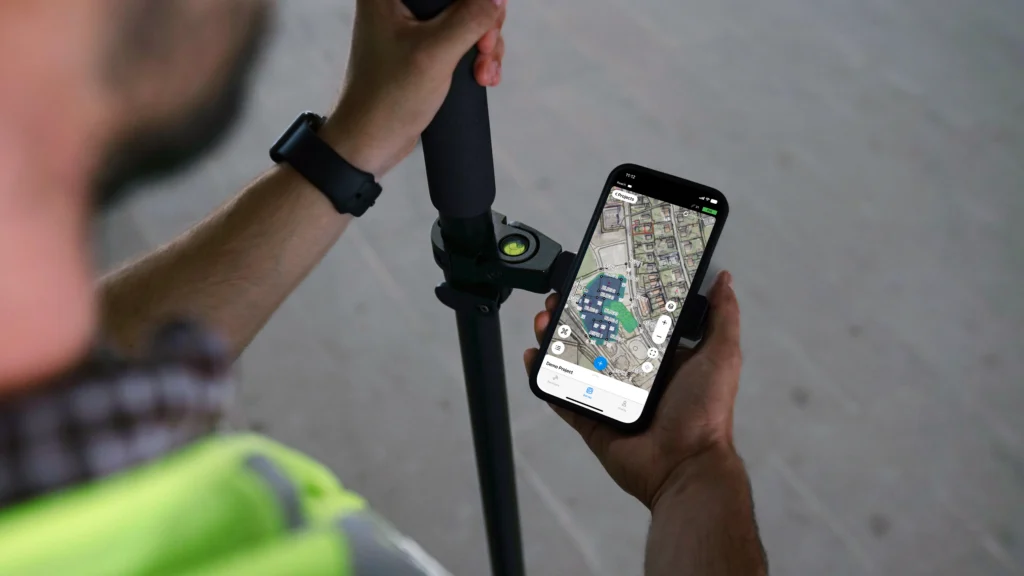
As a result, not every point can be verified, and teams may fall back on visual checks and tape measurements, or skip control steps to stay on schedule. This increases the risk that positioning errors go unnoticed until later stages, when corrections become costly and time-consuming.
To reduce this risk, teams can delegate routine quality control to field crews, while surveyors focus on critical measurements. With the Reach RS4 Pro, Emlid Flow, and Emlid Flow 360, QA/QC becomes part of the daily construction workflow rather than a separate process.
Related reading: Zero rework: how construction subcontractors win with GNSS
How do you build a reliable QA/QC framework?
Quality assurance in construction starts with a clear and structured framework. With Emlid, that framework has three parts: the receiver, the software, and a verified coordinate setup.
- Survey-grade GNSS receiver: The Reach RS4 Pro delivers RTK precision of 7 mm + 1 ppm horizontal and 14 mm + 1 ppm vertical. Its IMU tilt compensation needs no calibration, so crews can collect accurate points even when the pole isn’t perfectly vertical.
- Automatic sync between field and office: Emlid Flow is the mobile app crews use to control the receiver and collect data in the field. Emlid Flow 360 is the cloud platform where the office prepares, stores, and shares project data. Both stay in sync, so everyone works from the same version without manual file transfers. Project presets let you configure a project once and reuse it across the team. Here’s how teams use this to support the field remotely.
- Verified coordinate system registry with localization support: Projects can be set up in the required coordinate system and adjusted to site conditions through localization. You can import existing localization parameters through Emlid Flow 360 or get a localized version in Emlid Flow using control points. This ensures that all measurements align with the project grid and real-world conditions.
Together, Emlid Flow 360, Emlid Flow, and Reach receivers create a structured workflow: project data is prepared in the office, measurements are verified in the field, and results are reviewed across the team.
This helps construction crews maintain accuracy, detect potential issues early, and keep work moving without unnecessary delays.
Where do construction tolerances come from?
Before a crew can decide whether a check passes, it needs to know what it’s checking against. On most projects, tolerances come from three places:
- The project specification sets the tolerance for each element.
- The Inspection and Test Plan (ITP) defines the acceptance criteria for each check and who signs off.
Both usually point to a referenced standard for the actual numbers.
For concrete, that standard is often ACI 117-10, Specification for Tolerances for Concrete Construction and Materials. A few examples show how specific these numbers get:
- Top of foundation: up to 13 mm low, but not high (Section 3.3)
- Footing cross-sectional dimension: +50 mm, −13 mm (Section 3.5)
- Plan location: no single fixed number, because the tolerance scales with the size of the foundation (Section 3.2)
That last example matters most in practice. A GNSS check doesn’t pass or fail on its own. It passes or fails against a specific clause, so the crew needs to know which clause governs before deciding whether a reading is close enough.
How can field crews run quality control without a surveyor?
Quality control ensures that field-collected measurements align with the project design and meet accuracy requirements. With the Reach RS4 Pro and Emlid Flow, construction teams can quickly compare field measurements with design models and identify discrepancies before work progresses.
This way, instead of waiting for a surveyor, crews can check control points, confirm layout, and validate measurements themselves:
Align the project to reality with control checks
Field crews can remeasure control points to verify that the project setup is correct and that all work is aligned with the design. In construction, even small positioning errors can lead to costly rework, misaligned structures, or delays.
By comparing measured coordinates with expected values, crews can quickly confirm that the coordinate system, localization, and corrections are properly configured.
If the difference is within the project’s tolerance, the control point is considered reliable. If not, it signals a potential issue—such as an incorrect setup, shift in coordinates, or problems with corrections—that needs to be resolved before continuing work.
This step is essential because it ensures that all layout, stakeout, and measurements are based on accurate references, reducing the risk of errors propagating throughout the project.
Catch errors early with spot checks
During the process, site conditions can change, and small errors can accumulate over time. By periodically remeasuring selected points and checking grades with Emlid Flow, crews can confirm that positioning and elevations remain accurate throughout the project.
This helps detect shifts in control, setup errors, grade deviations, or construction discrepancies before they affect larger areas. Regular spot checks reduce rework, keep structures within tolerance, and maintain compliance with design specifications.
Document the check so it counts
A check that isn’t recorded won’t help you in a dispute. The ITP defines what evidence each hold point requires, and a GNSS check produces exactly that kind of record: a coordinate, a timestamp, and the solution status at the moment of measurement. In Emlid Flow, each point is saved with this data and synced to Emlid Flow 360, so the office has the record without anyone sending files.
How long you keep those records depends on your contract and on your state’s statute of repose, and both vary. Check them before you set a retention policy. Federally funded work has a fixed minimum: records must be kept for three years from the submission of the final financial report. The period is extended if litigation, a claim, or an audit starts before it ends (2 CFR 200.334).
Using the Reach RS4 Pro with Emlid Flow and Emlid Flow 360 allows teams to:
- Reduce downtime waiting for survey verification.
- Detect positioning errors earlier.
- Maintain consistent accuracy on site.
- Improve coordination between survey and construction teams.
Crews verify routine measurements on-site, and the surveyor’s visits go to the work that needs them. Learn more about Emlid Flow workflows in our documentation.
Take control of QA/QC with Emlid
QA/QC keeps construction work accurate, but it shouldn’t stop the crew every time a measurement needs checking. With the Reach RS4 Pro, Emlid Flow, and Emlid Flow 360, field teams confirm measurements as they work and keep the project moving. Surveyors spend their time on control, certification, and the work that needs their signature.
Frequently Asked Questions
Yes, for routine layout, grade, and spot checks. A common working tolerance is about ±2 cm horizontal for layout and about ±1 cm vertical for grade. Vertical is the weaker axis with GNSS, so confirm a fixed solution and watch your distance from the base and nearby obstructions. Always check the tolerance against your project specification.
From your project specification. The Inspection and Test Plan (ITP) defines the acceptance criteria and who signs off, and both usually reference a standard. For concrete, that’s often ACI 117-10.
A control check re-verifies the project’s reference framework at the start of work: control points, coordinate system, and localization. A spot check re-measures selected points during construction to catch drift, grade deviations, or setup errors before they spread.
For routine checks, yes. Certified or recordable as-builts and boundary work still require a licensed surveyor, and sometimes a Professional Engineer, depending on your contract and jurisdiction.
Most rework comes from miscommunication and inaccurate information. Checking installed work against the design in real time, and syncing the results to the office, catches those errors while they’re still cheap to fix.