
 BLOG
BLOG
How Emlid Reach GNSS receivers bring centimeter accuracy to ground-penetrating radar surveys
Ground-penetrating radar tells you what’s underground. But by itself, it can’t tell you where it is in real-world coordinates. The antenna records reflections as it moves, but those reflections are only positioned relative to your starting point—not to the site itself.
Add a centimeter-accurate GNSS receiver like Emlid Reach to the workflow, and everything changes. Now each radar reflection gets tied to an absolute coordinate. You go from scattered subsurface data to a mapped, actionable picture of what’s below.
This article shows how three real-world projects—utilities, archaeology, and geotechnical work—paired Emlid Reach with GPR systems and what they got out of it.
Integrating Emlid Reach with a GPR system
Integrating an Emlid Reach GNSS receiver with a GPR system ensures that GPR spatial data is accurate, repeatable, and interoperable with other geospatial data.
The workflow is straightforward and typically follows the same structure across most applications:
- An RTK base station is set up to establish the project coordinate framework and configured to transmit RTK correction data.
- A GNSS rover is then mounted on a GPR cart and paired with the base to receive corrections.
- Finally, Bluetooth or NMEA output is used to stream corrected positions directly into the GPR acquisition system.
This configuration ties every GPR measurement to a common reference frame so that the radar data aligns with other survey products such as GIS layers, point clouds, drone imagery, or CAD plans.
The following three examples show how this workflow is applied in real-world scenarios and how Reach GNSS receivers bring centimeter accuracy to ground-penetrating radar surveys.
Precise positioning technology supporting archaeological decision-making
A strong example of GNSS forming the spatial backbone of a geophysical project comes from specialist firm Geomorph Imaging Solutions (GIS) and the University of Michigan. Together, they conducted a non-invasive geophysical survey to detect, map, and characterize buried archaeological remains at the Sanctuary of Poseidon in Isthmia, Greece.
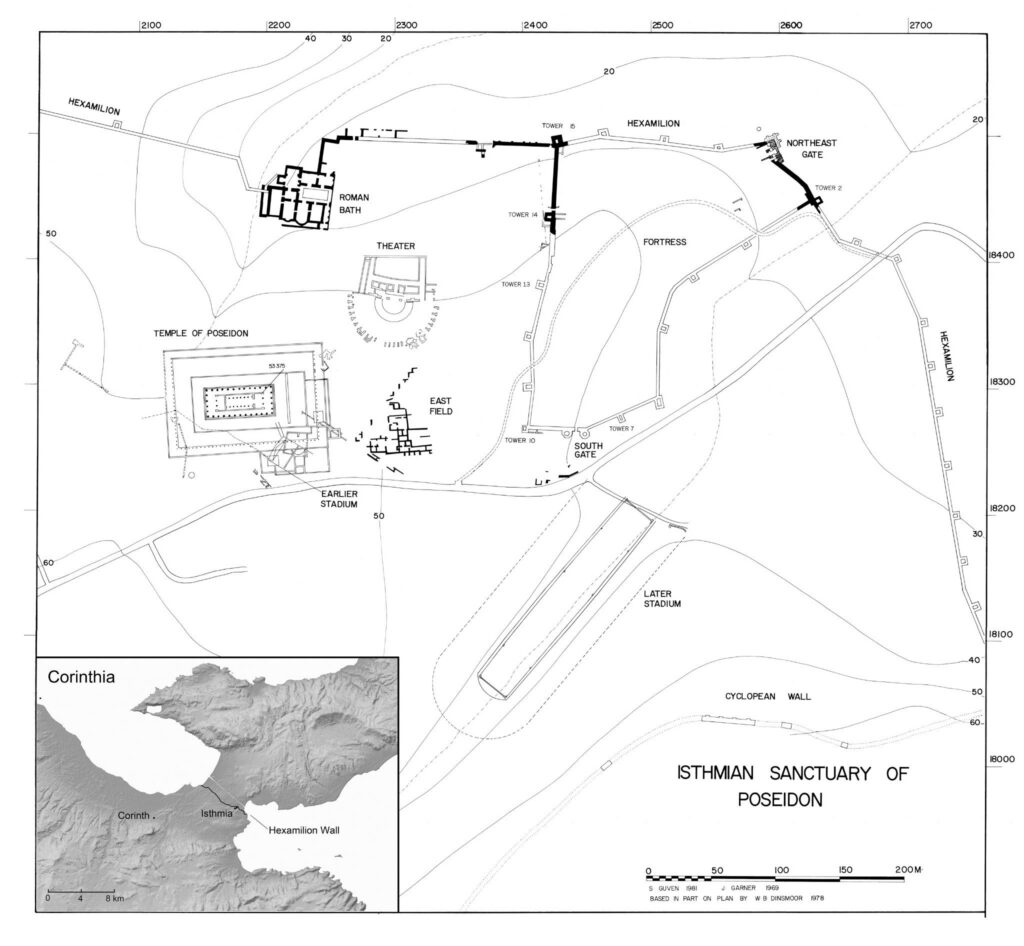
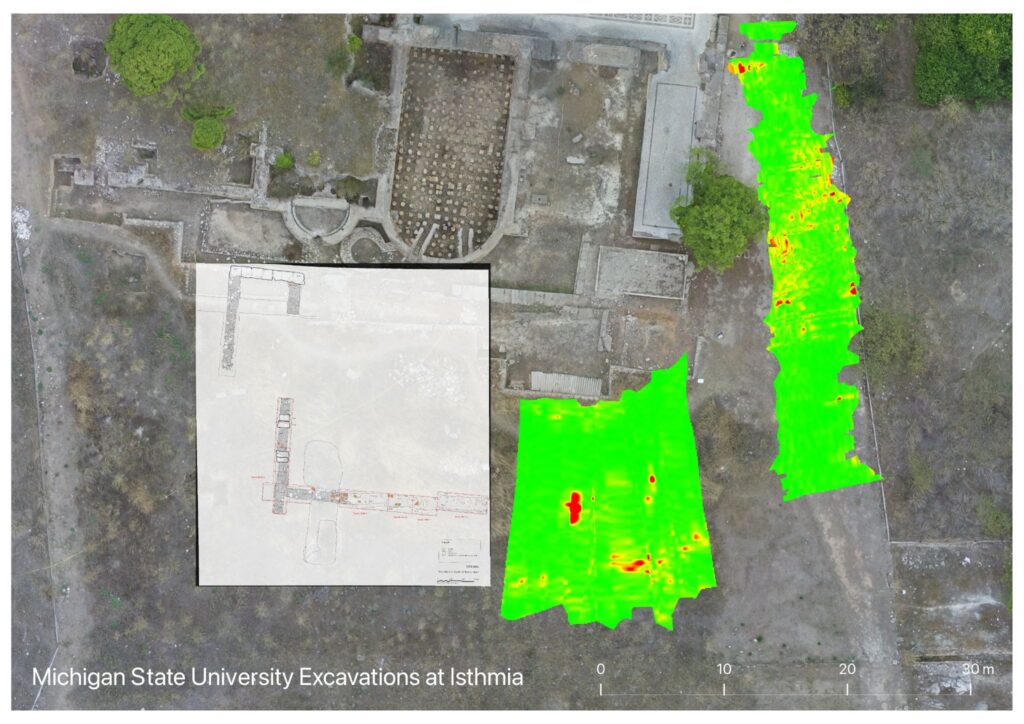
The survey focused on identifying subsurface architectural remains such as walls, rooms, bath structures, and roadways, while also defining new excavation targets.
High spatial accuracy was essential to the project because every detected feature needed to be reliably correlated with existing excavation areas and future trenches.
For this work, the Reach RS2 provided centimeter-level accuracy with extremely quick initialization and stable RTK fixes. Its lightweight and wireless setup made it easy to move repeatedly between grids and obstacles without workflow interruptions. This allowed us to maintain productivity while ensuring every GPR profile was precisely georeferenced.
Dr. Michael Arvanitis, Geomorph Imaging Solutions
This allowed the survey team to maintain productivity while ensuring that every GPR profile was correctly georeferenced despite the site’s added complexity, consisting of uneven terrain, obstacles, and irregular survey grids.
The project deliverables included georeferenced GPR profiles and depth slices, subsurface feature maps, and target coordinates for excavation.
Accurate GNSS positioning meant archaeologists could locate anomalies immediately in the field without additional surveying, improving excavation efficiency. The direct integration of accurate GNSS coordinates simplified post-processing and reduced time spent on alignment and corrections.
Using the Emlid Reach RS2, the team achieved several key outcomes:
- Consistent centimeter accuracy across fourteen grids.
- Fast setup and relocation between survey areas.
- Reliable RTK fixes in complex terrain.
- Seamless GNSS–GPR synchronization.
- Reduced field time and cleaner post-processing.
The result was a smooth, dependable workflow and high-quality spatial data that directly supported archaeological interpretation and decision-making.
Multi-sensor archaeology field projects
A second example of GNSS supporting data integration comes from the University of Copenhagen, where researchers used Emlid GNSS equipment to create a consistent spatial reference across multiple field campaigns in Greece and Italy, including Pompeii and Naxos.
Their work combined subsurface GPR measurements with other mapping methods to document buried archaeological structures and landscape features.
GPR traces and depth slices were used to produce georeferenced interpretation layers and mapping outputs that supported excavation planning, helped relate anomalies to known ruins, and improved understanding of site layout.
To ensure that all collected datasets aligned correctly, the workflow relied on a Reach RS2 base station providing RTK corrections in the field.
These corrections were distributed using Emlid’s NTRIP Caster, a free, cloud-based service that transmits RTK corrections from a GNSS base station to rovers over the internet. NTRIP Caster allows multiple rovers and devices to work from the same correction stream while remaining tied to one coordinate framework.
This approach reduced spatial inconsistencies and helped ensure that GPR results could be integrated with other datasets without manual alignment.
Field data collection was supported by the Emlid Flow app, a mobile application for iOS and Android that serves as the command center for Emlid Reach GNSS receivers. The app helped capture and manage spatial points and survey information in real time.
With this setup, GPR data could be collected with centimeter-level positioning, ensuring that subsurface slices and anomalies could be accurately overlaid with surface mapping layers and delivered as reliable excavation-ready outputs.
Precise positioning for underground utility location
A final example shows how precise positioning improves GPR data quality outside archaeology. Access Detection provides equipment and solutions for underground utility location in Sydney, Australia.
The company supports utility locators, surveyors, and field service professionals with a range of detection and mapping tools.
Access Detection Director Anthony Johnstone tested new equipment to complement a GPR workflow used for underground utility detection. He mounted an Emlid Reach RS2 base and rover system and a GETAC B360 rugged laptop on his ImpulseRadar Raptor Cart.
This allowed him to collect accurate positioning data alongside GPR measurements.
During this workflow, he found that Emlid’s GNSS system integrated smoothly with the GPR equipment, providing a reliable positioning layer for data collection.
Multiple applications, one workflow
Adding RTK GNSS to GPR enables accurate mapping of buried features, supports repeatable surveys, and makes it far easier to integrate GPR results with other datasets, including drone orthophotos, excavation grids, and LiDAR-derived terrain models.
All three case studies show that the success of GPR deliverables depends on using a consistent GNSS workflow:
- A Reach base station establishes the reference frame.
- A Reach rover mounted on the GPR cart receives RTK corrections.
- Corrected coordinates are streamed directly into the GPR system so that every trace and depth slice is captured in real-world coordinates.
Whether the goal is mapping buried walls in an ancient sanctuary, integrating multi-sensor archaeological datasets, or locating underground utilities in an urban environment, the positioning workflow remains the same.
With the right GNSS setup, GPR data becomes easier to interpret, easier to integrate, and far more useful for final decision-making.