
 BLOG
BLOG
How to switch your team to a new GNSS receiver without losing the crew
Switching GNSS vendors looks straightforward from a spreadsheet: you get the new receiver, plug it in, and surveyors start using it.
In practice, it’s an organizational puzzle. Adoption moves at the pace of your slowest crew, your most skeptical team members, and whatever specialized work they’re protecting.
This article walks through what that transition actually looks like at scale—based on a large surveying firm currently in the middle of it.
Start with the real financial case
Cost matters, but not in the way you might think.
A technical lead at a large, established European surveying firm operating across dozens of offices wasn’t shopping for a new GNSS receiver because of a single unit price. His firm was evaluating whether switching vendors made financial sense across hundreds of projects, thousands of field hours, and a decade-long hardware lifecycle.
As the technical lead explained, the cost of surveying is a major factor in which jobs the firm wins. Projects often come down to price rather than experience or reputation, so surveying more efficiently directly improves their odds of winning work.
This reframing matters for your internal case: when you’re building the argument for a vendor switch, don’t lead with hardware cost. Lead with project margins:
- Equipment costs aren’t just the receiver. You need spares, batteries, chargers, backup antennas, and a replacement cycle every 4 to 5 years. That’s the obvious part.
- Training is less obvious. A vendor switch means teaching your entire field crew the new system—once on day one, then again when software updates roll out. That’s people hours that aren’t billable. Multiply it across 26 offices and it adds up fast.
- Software licensing gets overlooked until you actually add it up. Annual subscriptions for post-processing software, data management tools, firmware updates, and support contracts compound over time, especially when you’re managing a fleet across multiple offices.
But here’s where this actually matters: field productivity. Say a new receiver cuts setup time by 15 minutes per site. Or it needs fewer re-surveys because the accuracy is better. Now multiply 15 minutes by 500 projects a year across your offices. That’s 125 hours back. At your billing rate, what’s that worth over five years?
A vendor that costs 10% more upfront but saves you 5% in field time and training overhead can actually lower your total cost of ownership. Better margins on every project, that’s the real case you make to your CFO.
Related reading: How to manage 10,000+ construction surveying projects and structure data at scale
Trust the pilot
The best insurance against a bad receiver choice is an honest pilot. This means committing time and variety to see how the new receiver actually performs across your real work.
The technical lead described buying an Emlid GPS a full year before the larger investment and testing it across different regions of the country, with different people, on different projects, and among teams with different attitudes toward adopting new technology—specifically to see how it performed. The firm was happy with the result.
This matters because a one-off test in ideal conditions tells you nothing useful. Real pilots expose workflow gaps, edge cases, and the quirky ways your surveyors actually work. By doing this upfront, the company could make the next investment decision from evidence instead of a feature sheet and a sales pitch.
Micro-friction kills adoption. Solve the boring stuff first
A good pilot proves the device works. But between “works in testing” and “gets used every day” there’s usually a gap. Here’s a few concrete examples that the company gave us—and it’s the exact pattern where adoption stalls:
- A surveyor has 30 minutes to test a new device before their next job.
- They open the app but can’t remember the password for their account.
- They try to reset it, but the email is slow.
- They’ve got 15 minutes left now.
- They decide to come back to it later.
The result? Two weeks have passed. They don’t come back on their own. Then a manager sends a reminder. They think “I should use this,” but they still don’t remember the password. Three more weeks pass. Everyone assumes they’re just resistant to change.
The device never gets a real test.
As the technical lead points out, the blockers are often small. A surveyor can’t remember the account password, and if they only have 5 minutes or half an hour to test the device and can’t find it, they simply stop—and it can be weeks before they pick it up again.
This is what we mean by micro-friction. It’s not a disagreement with the equipment choice. It’s password resets, unclear menus, a manual that’s hard to find, and a missing quick-start guide. Any tiny obstacle between intention and action kills momentum.
When you’re planning your rollout, solve the boring stuff first.
- Set up accounts and send passwords before the testing begins.
- Provide a one-page quick-start guide. Use detailed Emlid guides as a reference.
- Document the five most common questions your surveying team will ask.
- Make sure someone is reachable on day one if the first test doesn’t go smoothly.
The goal is to reduce the friction between “I want to try this” and “I’m actually using this” as close to zero as possible.
A surveyor who can get started in 5 minutes and see results will come back. A surveyor who gets stuck trying to find a manual will not.
What ease of use actually looks like in the field
When you’re evaluating GNSS receivers, it’s easy to get distracted by raw specs—antenna count, frequency bands, baseline length. Those matter for specific workflows, but what actually determines adoption is operational simplicity.
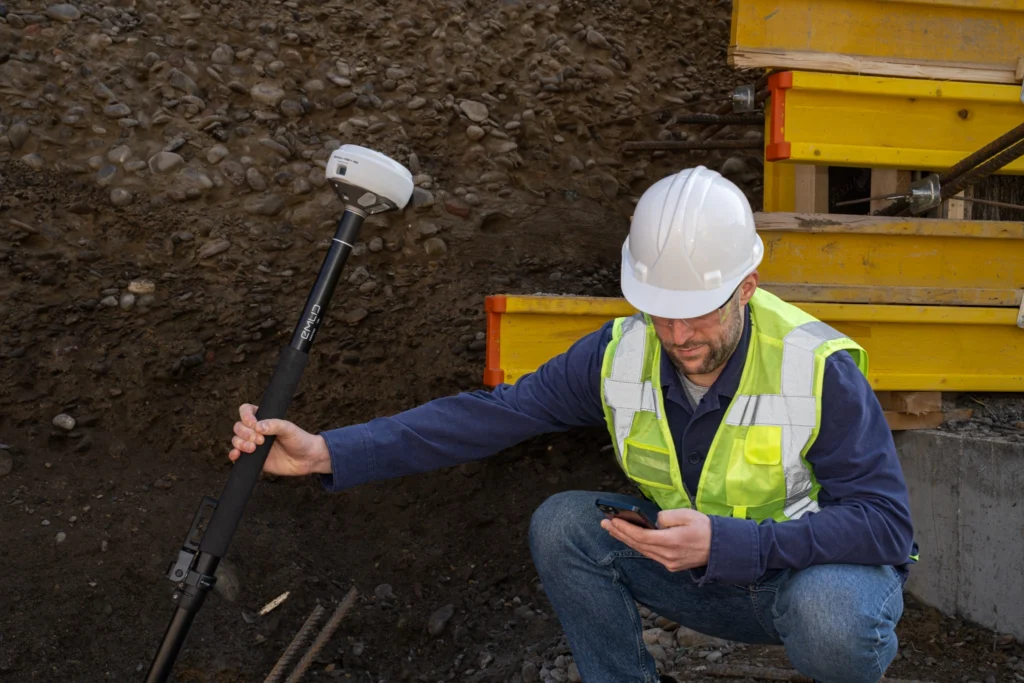
His team saw this firsthand when they tested Emlid Reach devices. The feedback was consistent across the board: the receiver was quick compared to their other instruments, starting almost instantly and connecting directly. The tilt function was fast to establish, the unit was lightweight, and the whole experience was intuitive and easy to use.
Each of those points removes friction:
- Speed means surveyors can test the receiver in the gaps between jobs.
- Lightweight means field crews will actually carry it.
- Quick tilt initialization means setup doesn’t become a blocker on high-stakes work.
- And intuitive means a surveyor who’s used the same brand for 15 years can pick it up without relearning how to think.
But hardware alone doesn’t solve adoption. Emlid Flow, the land survey app for Reach receivers, removes another layer of friction: it’s designed around how surveyors actually work.
At the team level, Emlid Flow 360 solves a real problem: when fieldwork finishes, data syncs automatically to the office. The surveying firm mentioned this exact issue—surveyors would measure things, skip the data transfer at the end of day, go on vacation, and the office would sit there for weeks waiting for files..
Build distributed accountability, not just a task force
Most large surveying firms have an internal task force or R&D group. A handful of people who track new equipment, attend industry events, and make purchasing recommendations. That’s necessary, but it’s almost never sufficient.
A task force recommendation from headquarters doesn’t automatically translate to a surveyor in a satellite office reaching for the new receiver on Tuesday morning. There’s a gap between “the company decided to switch” and “I’m actually using the new receiver on my next job.”
The missing piece is distributed accountability:
- Someone in each office who owns the local relationship with the new receiver.
- Who asks their colleagues what they’re running into?
- Who becomes the first port of call when a surveyor has a question?
This person doesn’t have to be your most senior surveyor. They just have to be curious enough to learn the receiver a week before everyone else and accessible enough that their colleagues actually ask them questions.
Practically: before rolling out new receivers, identify someone in every office. Preferably someone who already has informal influence—the person colleagues ask for advice. Brief them ahead of time. Give them access to support. Let them know they’re the first point of contact for their location.
Related reading: Minimize construction site visits: how to support your field crew remotely
Expect uneven adoption. And design for it
When you order new receivers for your whole team, half will integrate them smoothly. The other half will set them aside. That’s normal. What’s not normal is treating the second group as a problem.
As the technical lead notes, the people who are hardest to win over are in some cases the most important ones. These are often your most experienced surveyors, the ones doing your most demanding work. They’re not avoiding the new tools because they’re technophobic, they’re being cautious because they have the most to lose if something goes wrong in the field.
Here’s where most rollouts stall: management pushes adoption, experienced crews stay quiet and don’t use them, and nothing actually changes. Instead, flip your strategy. Design around the skeptics.
Start with one of your most demanding jobs—the kind where accuracy matters most and failure is expensive. Run it with the new receiver. Invite the experienced surveyor who’s been most hesitant to watch, or better yet, to run part of it alongside the new system. Show them the actual result on an actual project they care about. Not in a demo. In the field.
Then ask specifically: “What would make you feel confident enough to use this on your own?” The answer is rarely “the product needs different specs.” It’s usually “I need to know it works on X type of ground” or “I need to see the numbers match our old system” or “I want to try it on a lower-stakes job first.”
Build your rollout plan around those answers, not around the people who said yes on day one.
How peer learning works: and where it breaks down
There’s almost always one or two surveyors per location who are quick to pick up new receivers. They experiment, they get comfortable, they become the person everyone else asks.
This is incredibly powerful. When it works, adoption in that office accelerates. Surveyors don’t need emails from headquarters—sometimes they have someone at the next desk who already knows the receiver and can answer their questions in five minutes.
The fragility: this only works if you have an early adopter in every office. In smaller satellites or offices where everyone’s more traditional, if no one volunteers, adoption stalls. Hard.
Practical takeaway: before the new receiver arrives, identify or recruit an early adopter in every office. Make it formal. Give them some time to play with the receiver before launch day. Brief them on common questions. Make them the first point of contact for their location. Top-down emails don’t beat having someone trustworthy sitting next to you.
Run a low-stakes first job together
The first time a surveyor uses a new receiver matters a lot. If it goes smoothly, they’re more likely to try again. If it goes sideways—a timeout, a connection drop, something confusing—they’ll put it aside for weeks.
Practical takeaway: pair your early adopter with a skeptic on a small, low-pressure job, not a high-value project with a waiting client. Think about something where an extra 15 minutes won’t break the day. Then, let them see that the receiver works in practice, not in a demo. This is worth the invested time.
Give people permission to be slow
Adoption may feel like a gradual movement: some people will shift to the new receiver overnight, some will keep their old equipment in the truck for 3 months “just in case” before they trust the new one fully.
This is normal: it’s caution, and it’s reasonable in high-stakes fieldwork. Respect it. The surveyors who seem slowest to adopt are often the most thorough. Once they’re convinced, they’re reliable converts.
Practical takeaway: frame the adoption as a transition. “By the end of Q2, we’ll be running primarily on the new equipment” works better than “Starting Monday, everyone uses the new receiver.“
What happens during the adoption: real workflow gaps
Even with a great pilot, a solid team, and clear adoption planning, new receivers will surface workflow-specific gaps you didn’t anticipate. These only show up when you’re running real jobs at scale.
The firm discovered one in utility surveying. They’ve been working with DXF files (vector drawings imported from design software) for decades. For example, you work with DXF files, but some of your surveyors don’t know how to import them and just use points and lines files.
It’s not something they’ve needed to do—their legacy workflow handled this differently.
You’ll find gaps that the new receiver can’t immediately solve. Once you spot it, you can train around it, build a workaround, or discover that the new tool does something better. But you can only spot it once you’re live.
Name the gaps honestly inside your team instead of treating them as reasons to stall adoption. You find them, decide what to do, and move forward.
Tying it back together
Switching GNSS vendors is really an organizational redesign—a chance to reshape workflows, build better processes, and upgrade how your teams actually work. The receiver itself is rarely the obstacle.
The obstacle is adoption—getting experienced crews to trust the new receiver, removing micro-friction that kills momentum, and building accountability at every level of your organization.
Here’s what teams that switch successfully have in common:
- They make the financial case about winning bids, not unit cost. Hardware expense shows up on every project for the next decade. That’s the frame that matters.
- They solve the boring operational stuff first. Clear passwords. Quick-start guides. One clear point of contact. The software feels responsive. These details determine adoption more than specs do.
- They run honest pilots. A few receivers tested across your actual work for a meaningful period. Not a sales demo. A real stress test.
- They build distributed accountability. A task force makes decisions. But adoption happens when someone in each office is responsible for keeping momentum going and answering the small questions that matter most.
- They design adoption around the skeptics, not the enthusiasts. Your most experienced surveyors might be your slowest adopters. They’re also the ones whose buy-in determines whether the rollout is real.
Every transition surfaces gaps. Find them early. Name them honestly. Decide what to do. This is normal. It’s not a reason to stall.
The firms that finish their transitions quickly and keep their best people engaged are the ones that treat this as an organizational challenge—not a hardware problem or a management failure.
If you’re thinking about what a vendor switch could look like for your firm, reach out. We’ll walk you through how a pilot actually works and what it would take to test the Reach RS4 Pro across your real work.
Customer story: high-speed water infrastructure layouts and as-builts with Emlid
Customer story: scaling earthworks and utility projects with GNSS for construction
QA/QC workflows in construction: a practical guide for your field crew
RTK corrections delivery method explained: how to choose the right setup?