
 BLOG
BLOG
Customer story: high-speed water infrastructure layouts and as-builts with Emlid
With crews spread across job sites from Texas to Florida to Virginia, getting the right tools into the right hands has been a long-standing challenge—and affordability has been a big part of the answer for Garney.
We’re talking about a major US contractor focused exclusively on water and wastewater infrastructure, which decided they weren’t going to “deal with it” the old way.
In a conversation with the Emlid team, Garney’s Technology Manager, Scott Brown, broke down what’s changing on their jobsites: fewer bottlenecks, fewer data handoffs, and fewer people doing risky work just to capture a point.
- The bottleneck: legacy workflows that stall the job
- An opportunity to change: how we came into the scene
- Cloud-first field data: fewer handoffs, fewer headaches
- Keeping workers out of the ditch: safety meets better deliverables
- Building what the field reality demands
- Rethinking field data starts with removing friction
The bottleneck: legacy workflows that stall the job
Garney’s challenge wasn’t that positioning data was impossible to collect; it was the one setup that had to serve an entire site, and everyone ended up waiting. As Brown put it: “Our limitation right now is we take one expensive kit, and we kind of share it amongst the whole job, and it’s just hard to do successfully.”
Then comes the data shuffle—and every handoff is another chance to lose time or accuracy. Brown described a workflow that’s way too familiar across the industry: his team handles the same data five or six times before it ends up where it’s supposed to go, opening up chances for error and adding up to a lot of wasted motion.
An opportunity to change: how we came into the scene
Garney’s approach is blunt in the best way: if it’s annoying, it won’t scale in the field.
That’s a big reason Garney has been rolling out Emlid receivers—Reach RS4 Pro and RX2—so more roles can do real work without waiting for the “one special kit” to become available. The shift isn’t just about survey specialists anymore.
Brown described how adoption expands when tools stop being gatekept by complexity:
“It was used just by field engineers, but the supervisors are going ahead… We want to have a product that is still super high accuracy, but it’s more affordable, and we can get it in more people’s hands”.
Scott Brown – Garney
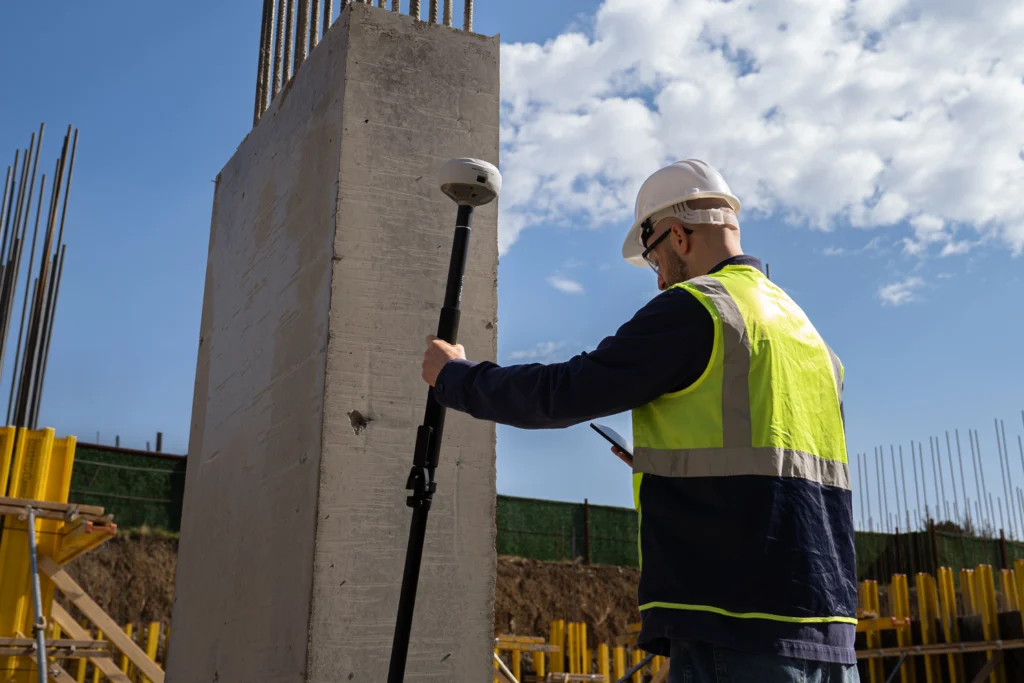
Checking building corners with the Reach RS4 Pro
Cloud-first field data: fewer handoffs, fewer headaches
Garney’s focus is straightforward: capture data in the field, move it quickly, and stop chasing files.
Brown has been pushing to reduce the number of times the same data gets touched—every export and re-upload is another chance for something to go wrong. As he put it: “The fewer times we can handle the information, the better.”
That’s where Emlid Flow and Emlid Flow 360 come in. The field team captures data on their phones with Emlid Flow, paired to the receiver. The project lives in the Emlid Flow 360 cloud workspace, so the office and the field are looking at the same files in the same place.
That’s the part Brown likes most: “I love the backend office side of it where it’s like, ‘Hey, I’m having trouble getting this file.’ I jump in there, dump it in there—’You see it?’ ‘Yeah, I see it. There you go.’ It’s just so easy.”
For Garney, the value is in shortening the path between capture and delivery and removing the friction in between. And they see it working in the long term: “I see a world where a lot of our traditional GPS-type work that we do now could be replaced with Emlid Flow.”
Related reading: Minimize construction site visits: how to support your field crew remotely
Keeping workers out of the ditch: safety meets better deliverables
One of the biggest shifts Garney was testing is how they capture pipeline as-builts.
The traditional workflow is straightforward: install the pipe, secure it, then climb down and shoot both ends. As explained, “They climb down on the pipe, and they take a shot on each end.” In the long run, that can mean hundreds—sometimes thousands—of trips into a trench.
Instead of only collecting discrete GPS points, Garney is scanning pipe runs using Emlid Reach RX receivers paired with the DroneDeploy photogrammetry app. They’re not abandoning traditional shots. They’re comparing them. For each section, they log the GPS as-built, extract the scan position, and measure the delta.
The idea is simple: build enough data to prove the scan holds up.
The upside goes beyond reducing trips into the trench. With scanning, “We get the photos, and we get a 3D model.”
On treatment plants, intersections, or anywhere future disturbance is likely, that full 3D record becomes valuable long after backfill.
Building what the field reality demands
Garney is building a practical toolkit that people choose because it removes pain.
Brown’s philosophy is simple: adoption is the metric. “The best judge of a technology is if people want more of it.” And he’s clear-eyed about the real world: no two jobs are ever identical, even when they look the same on paper. So what does “the future” look like on a jobsite like Garney’s?
More connected workflows. More people empowered to solve problems without waiting. Less time moving files around. And fewer reasons to put someone in harm’s way just to capture a couple of points.
Or, in Brown’s words: “The simplicity… is where people are really going to pick up and be like, ‘Oh, wow. I like this.’”
Rethinking field data starts with removing friction
Garney didn’t overhaul their workflows overnight. They started by asking simple questions:
- Why are we sharing one kit across the job?
- Why are we touching the same file five times?
- Why are we climbing into trenches just to capture a point?
With Emlid Reach receivers and the Emlid Flow app, they began reducing those friction points, making it easier for more people to capture accurate data, move it to the cloud, and deliver it to owners without the usual back-and-forth.
If your crews are still waiting on equipment, chasing files, or relying on disconnected workflows, it may be time to simplify the system around your data—not just the hardware in your hands.