
 BLOG
BLOG
GNSS workflows for any construction team that cut your costs
Accuracy is critical in construction: tolerances are tight, and mistakes are expensive to fix. That’s why many projects slow down because crews have to wait for a professional surveyor to arrive and do the job accurately.
This can create a false choice: wait while people and machines sit idle, or keep moving and risk losing accuracy and accountability.
In fact, today, construction teams don’t need to replace surveyors. Instead, they can handle simple tasks in-house and bring in surveyors for complex work. With modern GNSS tools, field crews can take care of routine layout, checks, and documentation, reducing delays, speeding up workflows, and improving ROI.
- Key takeaways
- Why does relying on surveyors for every task slow projects down?
- Can non-surveyors really collect accurate GNSS data?
- How do field crews get centimeter accuracy? Base station vs. correction network
- What survey jobs can be done with GNSS?
- Remote oversight for managers: real-time control without site visits
- Where do in-house GNSS measurements end, and surveyors remain essential?
- Eliminate waiting, not GNSS accuracy
- Frequently asked questions
Key takeaways
- Projects stall while crews wait on a surveyor’s schedule, and in busy markets, survey turnaround can run two to four weeks.
- Field rework is widely estimated at around 5% of total project cost, with a range of 2–20% depending on project type, much of it traced back to poor information and late checks, not bad workmanship.
- Crews own routine layout, grade checks, as-builts, and topo; licensed surveyors stay focused on control, boundaries, certified deliverables, and high-tolerance work.
- RTK GNSS delivers roughly 1–2 cm accuracy in open sky.
Why does relying on surveyors for every task slow projects down?
Surveyors are essential on construction sites. They set control, verify boundaries, and handle high-risk measurements that really can’t go wrong.
The problem starts when they’re treated as a general-purpose resource for every positioning task. That’s when things begin to slow down:
- Idle machines and crews: expensive equipment such as excavators and dozers (and their operators) ends up waiting. In many cases, a simple grade check costs more in downtime than the measurement itself.
- Schedules built around availability, not readiness: work gets delayed not because crews or materials aren’t ready, but because the surveyor isn’t available yet.
- Errors discovered too late: when checks happen infrequently, mistakes can be found only after the work is done.
This goes beyond a scheduling inconvenience, it reflects a structural constraint that’s becoming more severe.
The construction workforce is aging and shrinking: the Associated Builders and Contractors estimates the industry needs roughly 349,000 net new workers in 2026, and the National Center for Construction Education and Research projects that about 41% of today’s workforce will retire by 2031.
Skilled specialists like surveyors are exactly the resource that’s hardest to add. When they’re the only people who can perform routine checks, availability becomes the ceiling on how fast a project can move.
But what if most of these tasks don’t need to be done by highly trained surveyors?
Even when the professional does get to the field, they spend time on routine checks instead of the work that actually requires their expertise. The most efficient construction teams use surveyors strategically, keeping them focused on critical tasks.
Can non-surveyors really collect accurate GNSS data?
Yes, when the workflow is designed for it. Modern GNSS systems make it possible for non-surveyors to collect centimeter-level data reliably, without guesswork or deep surveying expertise. In good conditions, RTK positioning delivers roughly 1–3 cm horizontal accuracy, which is well within tolerance for the majority of construction layout and topographic work.
When a GNSS receiver is connected to a correction source, it delivers survey-grade RTK positioning. Field apps then guide users through setup and calibration, enforce best practices, and immediately flag issues like poor residuals or unstable solutions. This prevents most common mistakes before they affect the data.
How do field crews get centimeter accuracy? Base station vs. correction network
There are three practical ways to feed a rover the corrections it needs, and the right one depends on where you’re working:
- Your own base station (radio, LoRa, or UHF): the base sits on a known point and streams corrections directly to the rover. Best for remote sites, corridors, or anywhere cellular coverage is weak, no internet required.
- A correction network (NTRIP / CORS): the rover pulls corrections over the internet from a network of reference stations. Best for urban and suburban sites with reliable cell data, and it removes base-setup time. In the US, the NOAA National Geodetic Survey’s CORS network is a free government service; Europe has the EUREF network.
- PPK (post-processed kinematic): the rover logs raw data and corrections are applied later. Useful as a fallback when the real-time link drops, or when you need stronger auditability for deliverables.
Related reading: our full explainer on how RTK corrections work, from base station to NTRIP service.
That’s the technology. Now let’s look at how it works on real construction sites.
Matt Kippelen, Digital Innovation Manager at Menard, USA, shared how switching to Emlid GNSS didn’t just change their workflows, it changed who could confidently perform survey-related tasks on site.
“We were users of another manufacturer, and we still have about 15 or 20 units in circulation. But we’re now discussing pulling those out of service to avoid running a mixed fleet—because there’s a general consensus that people prefer using Emlid.
The product is impressive and very user-friendly. It’s easy to train new engineers on, which matters for us because our use case is a bit different. We’re a construction company using Emlid to survey points on active job sites, and the users are field engineers—often younger people who are early in their careers. It’s not seasoned surveyors with decades of experience. That’s just not how our teams work.”
— Matt Kippelen
What survey jobs can be done with GNSS?
Modern GNSS puts survey-grade accuracy directly in the hands of construction teams. With guided workflows and built-in checks, crews can handle layout, verification, and documentation themselves, without cutting corners.
The key isn’t doing everything in-house. It’s knowing which tasks you can safely own, and when a licensed surveyor still needs to step in.
Below are the GNSS tasks construction teams can confidently handle on their own.
Grading & Cut/Fill verification without stopping production
In earthworks and construction, grade verification often turns into a bottleneck. Work slows down (or stops entirely) while crews wait for a surveyor to confirm the grade.
When verification isn’t available right away, the team is forced to rely on visual estimates. That’s risky: over-excavation is a common result, and fixing it means backfilling, compaction, and rework, costing both time and money.
This matters because grade and earthwork errors feed directly into one of construction’s largest hidden costs. Field rework is commonly estimated at around 5% of total project cost, and studies put the range anywhere from 2% to 20% depending on project type. On earthworks, over-excavation also wastes imported fill and machine hours you never get back.
A GNSS-based workflow changes that. With Emlid Reach receivers, grade verification becomes a real-time part of production: design surfaces (DTMs) are uploaded to the Emlid Flow field app on a rugged smartphone or tablet, so crews can check grades as they work, without stopping the job.
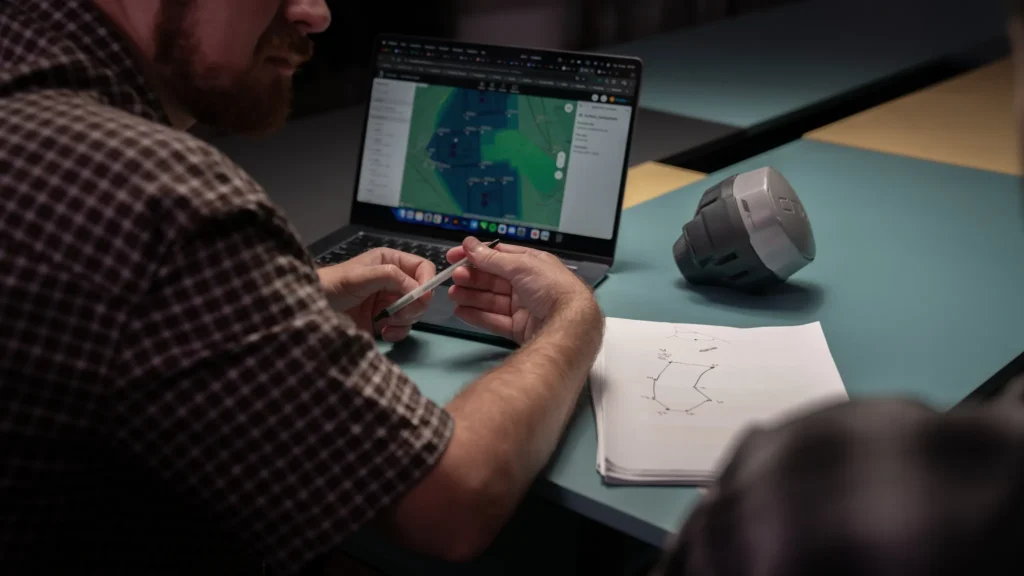
When a GNSS rover pole is placed on the ground, the Emlid Flow app instantly shows the difference between the actual elevation and the design grade. Crews verify grades without stopping the machine or leaving the work area, and operators or foremen can check the quality of the work on the spot and make adjustments immediately. A manager can prepare the project in the Emlid Flow 360 app from the office and review the on-site checks in real time.
This real-time feedback brings clear advantages:
- Errors are fixed right away, before they turn into costly rework.
- Machines stay productive longer, improving the return on investment for heavy equipment.
- Progress to final grade is faster, helping projects stay on schedule.
A note on machine control. On large earthmoving jobs, contractors increasingly go a step further with 3D machine control, where the design surface is loaded into the cab and the blade or bucket references it continuously, often reaching finish grade in a single pass and cutting rework, fuel, and grade-checking labor.
Rover-based verification with a receiver and field app is the complementary crew workflow: it lets a foreman confirm the machine’s result, spot-check between passes, and document grade without calling in a surveyor.
QA/QC verification before mistakes become permanent
In many construction projects, issues such as missing sleeves, misaligned anchor bolts, or flawed formwork become visible only after the concrete has been set. By then, crews may need to cut through cured concrete, re-pour, or redesign around the missed elements.
This is another surveyor bottleneck. When crews rely on availability to verify work, checks can be infrequent or rushed, and important details are missed.
That’s costly precisely because so much rework is an information problem and not a workmanship one: industry research attributes a large share of construction rework to miscommunication and inaccurate or missing documentation rather than poor execution. Catching a discrepancy against the model before the pour is the cheapest fix there is.
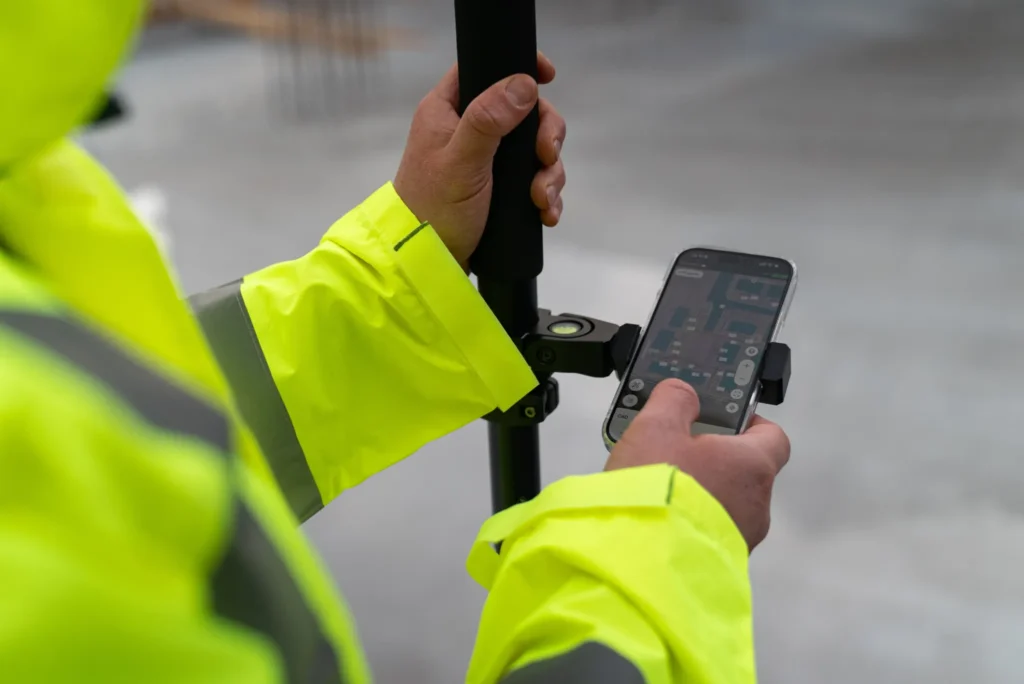
With Reach receivers and Emlid Flow 360, you can integrate high-accuracy positioning directly into the field verification process. Instead of working from abstract plans, CAD drawings are imported as georeferenced background maps, providing a live, contextual reference. This lets construction professionals, particularly superintendents, see building lines and design features directly overlaid on their position on the job site.
This shifts QA/QC from spot-checking points to verifying the whole layout in context. Before a concrete pour, superintendents can walk the site with a Reach receiver and the Emlid Flow app to catch issues early, while fixes are still easy. They can:
- Stake out and verify sleeves against the digital design to confirm placement, orientation, and diameter.
- Check anchor bolt locations and elevations to guarantee they match the requirements for the steel connection, preventing delays during erection.
- Confirm the alignment and elevation of formwork so the poured concrete cures to the precise dimensions and plumb required by the structural plans.
GNSS flips QA/QC from fixing problems after the fact to catching them before they happen. The results are straightforward:
- Catching issues before they become permanent: resolving errors in sleeves or anchors while they’re still temporary fixtures (rebar cage placement, form stops) rather than cured concrete.
- Objective, location-based proof: GNSS captures accurate coordinates, offering measurable evidence of a feature’s position relative to the design model, a clear audit trail if a dispute arises later.
- Fewer downstream delays and change orders: eliminating early errors cuts expensive rework, minimizes schedule disruptions, and reduces costly change orders.
With cloud tools like Emlid Flow 360, managers don’t need to be everywhere at once. Every point, stake, and accuracy check is logged automatically, creating a clear audit trail that can be reviewed remotely. That means better oversight, fewer site visits, and tighter control over quality, without slowing the job down.
Related reading: a deeper dive into QA/QC workflows in construction with GNSS, and how modern GNSS hardware is designed for large-scale construction environments.
Simple design layout and staking without schedule delays
Boundary surveys and high-risk structural work still need a licensed surveyor. But most day-to-day layout (excavation limits, footings, curbs, storm drains) doesn’t.
With GNSS on site, a single operator can stake out points quickly (in open conditions, RTK is typically several times faster per point than an optical total station), restake anything knocked out by weather or equipment, and keep moving instead of waiting. Design files go straight from the office to a phone or rover, cutting out paper plans and manual interpretation.
Using Reach receivers with the Emlid Flow app, users see their live position, accurate to the centimeter, relative to the project plan on their screen. The software directs them to the correct location for a stake, pin, or paint mark, so field teams can take immediate control of routine layout.
Know where the line is. What crews can self-perform depends on your jurisdiction. Rules vary by state: routine construction layout can often be handled in-house, but certified staking, legal boundary determination, and documents required for permits, inspections, or lender draws generally must be performed or sealed by a licensed professional surveyor. Some states regulate contractor-performed staking more tightly than others, so confirm your local licensing-board requirements before assigning work.
Related reading: how subcontractors and specialty contractors use RTK GNSS for grade checks, stakeout, and as-builts.
As-built and utility digitalization before backfill
Once underground utilities are buried, they’re easy to lose. Paint fades, stakes get crushed, and when the location data is gone, finding utilities later gets slow, expensive, and risky.
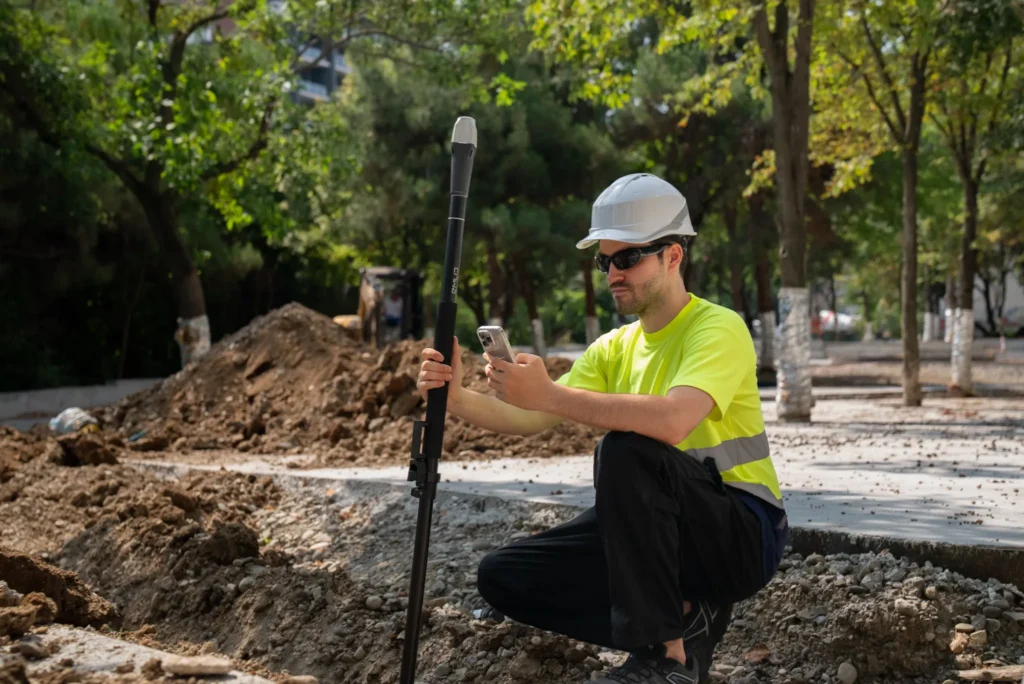
Here’s where GNSS makes a difference. Before backfill, crews walk the trench with a rover and capture utilities as they go. Every point is logged with exact coordinates, a timestamp, and photos, no guessing later, and a verifiable record if a location is ever disputed.
With tilt compensation, the pole doesn’t need to be perfectly upright. You can measure safely from the edge of the trench and still get accurate results. Take the Emlid Reach RX2: it holds accuracy even when severely tilted, at 30° of tilt it still delivers roughly 18 mm precision, which is a big deal for safely measuring deep trenches from the edge. You won’t need anyone to go down into the trench, which cuts out confined-space risk and helps meet safety rules.
Related reading: GNSS for utility and wet-utility work, from stakeout to as-built, and how the Reach RX2 enables simple, scalable capture for GIS and construction.
Topographic surveys for earthworks planning and progress tracking
Accurate topographic data is critical at the beginning of a project and throughout construction. Before earthworks begin, contractors need to understand the actual terrain, the data is used to validate digital designs, calculate cut/fill volumes, and confirm that bids are based on real conditions.
The risk of getting it wrong is significant. If a contractor estimates moving 5,000 m³ of material but the site actually requires 7,000 m³, the additional cost can erase the project’s entire profit margin. Capturing terrain in-house de-risks the bid before a single machine mobilizes.
With Emlid Reach receivers such as RS4 and RS4 Pro, in-house teams can gather terrain and elevation data accurately. A use case from Construction Manager Michael Lambert in the USA shows exactly how this helps. During the early planning phase of a large project, Michael needed accurate site data immediately, but survey resources weren’t readily available.
He was responsible for BIM coordination and early field engineering tasks, even though field engineering wasn’t formally part of his role, and waiting weeks for a rental-grade GNSS unit or a survey crew wasn’t an option.
“Here I am on the ground. I need to start capturing data now. And it might take two or three weeks to get a rental unit.”
— Michael Lambert
Instead, Michael used the Emlid GNSS gear he already had and started capturing site data right away. He documented existing conditions and supported early planning, access routes, parking, material storage, long before construction kicked off. “What really helped the most was at the very beginning of the project,” he said. Because the equipment was accurate and cost-effective, it could be assigned directly to the job site rather than treated as a scarce, rented resource.
By collecting topo data in-house, Michael skipped early delays and kept planning moving, using the workflow whenever data was needed, not just when a surveyor was available.
Related reading: how the Emlid Flow site survey app powered a 70-acre construction project.
Drone mapping with GNSS control for fast, scalable site visibility
Drones equipped with RTK GNSS offer a simple way to monitor and measure a site, capturing topographic surveys, tracking daily progress, calculating stockpile volumes, and validating as-built conditions. With just an RTK drone, a GNSS base for corrections, and a few ground control points, you can plan a flight and collect georeferenced images in minutes. Well-controlled drone surveys reach the few-centimeter accuracy band that earthwork volume and progress work needs.
If you’re worried about cost, rest easy: today’s RTK drones and GNSS receivers have become far more affordable and intuitive. To launch an in-house drone program you need a one-time investment in a small drone, a reliable GNSS base, and beginner-level pilot training (in the US, the FAA Part 107 Remote Pilot Certificate). That investment pays for itself quickly by saving labor, preventing rework, and giving you accurate data on demand.
Scott Brown, construction technology manager at Garney, got started with RTK drone mapping by pairing a Reach receiver with an off-the-shelf quadcopter. “RTK with a Mavic… what did I have at the time? I had a Mavic 2 Pro,” he recalls. The decision to use Emlid receivers came down to affordability and simplicity: instead of lugging around a traditional survey kit, he wanted a small GNSS base he could throw in a case and take to the site.
Working together, a drone and a GNSS receiver deliver several benefits on site:
- Improved safety. Inspect hard-to-reach areas from the ground instead of sending personnel into hazardous zones.
- Quick, accurate surveys. Fly large areas and get centimeter-accurate maps without lengthy setups or all-day on-foot surveying.
- Reduced rework. Identify issues early and compare design models to reality to catch misalignments before they become expensive mistakes.
- Better collaboration. Share up-to-date 3D models and orthomosaics with everyone, from field crews to stakeholders, so decisions are based on the same information.
Remote oversight for managers: real-time control without site visits
Managing teams across multiple job sites is a constant balancing act. Keeping an eye on quality, catching issues early, and answering field questions usually means a lot of driving, and a lot of wasted time.
Field-to-office data sync changes that. The disconnect between field and office is a documented drag on productivity: in traditional workflows, survey data can take hours to move from the field controller to the office. In one connected-workflow case, contractors cut that reporting turnaround from about 90 minutes to 10–15 minutes.
With the Emlid Flow 360 cloud platform, field data shows up in the office instantly. Managers can review measurements, spot problems, and push updates while crews are still on site, no travel required. It’s like having a virtual survey lead on every job.
Equipping the earthworks supervisor with survey-grade GNSS
For Daniel Kenny, Head of the Surveying Department at KLS Earthworks, this visibility isn’t a nice-to-have: it’s how he keeps dozens of projects moving at once.
In the slow season, KLS typically has around 30 active job sites. At peak, that number can climb to 60 running simultaneously. Supporting that scale with a surveyor-only model simply wasn’t realistic. Surveyor availability was a constant constraint, simple tasks like checking elevations often couldn’t be done in time. If an earthworks supervisor needed a quick elevation check and Daniel couldn’t get there, the workaround was manual methods.
The risk was obvious: without proper verification, mistakes happened. Crews could get it wrong, and there was no easy way to confirm accuracy. In some cases, general contractors or inspectors would stop work entirely because a surveyor hadn’t been on site to verify the layout.
Before Daniel joined KLS, supervisors had access to full survey-grade equipment. On paper it should have worked; in practice it didn’t. The tools were too complex for non-surveyors. Even after formal training, supervisors struggled to use them correctly and quickly abandoned them. Within months, the knowledge was gone.
Instead, KLS now equips its site supervisors with Emlid GNSS receivers and the Emlid Flow app to use directly on site. Surveyors retain control of the system setup and coordinate framework, while supervisors handle routine checks and layout as part of daily production. As Daniel puts it, they had been using equipment they shouldn’t have been using for the type of work they were doing. With Emlid, that dynamic flipped: supervisors who previously avoided GPS altogether now use GNSS confidently. The workflow is simple enough to stick to, and accurate enough to trust.
Related reading: how to support your field crew remotely with a connected field-to-office workflow.
Where do in-house GNSS measurements end, and surveyors remain essential?
Empowering construction teams with GNSS does not mean eliminating surveyors. Drawing the line clearly is what makes the model work. Professional surveyors remain essential for:
- Legal boundary surveys and property-line determination.
- Establishing and verifying control networks and site calibration.
- High-risk, high-tolerance work.
- Regulatory, contractual, and permit sign-offs that must be sealed by a licensed professional.
There’s also a technical boundary worth understanding, because RTK GNSS isn’t the right tool for every measurement. RTK is accurate to roughly 1–3 cm and depends on a clear view of the sky. When a job calls for millimeter tolerances, precise structural alignment, machine calibration, deformation monitoring, or when satellites are blocked by dense tree canopy, building interiors, tunnels, or tight urban corridors with multipath, a total station is the appropriate instrument.
Many crews use both: GNSS for fast, open-site production and control, and a total station for confined or high-precision work. A useful rule of thumb is that tolerances tighter than about 10 mm point toward a total station.
The most successful projects define these boundaries clearly. Routine GNSS tasks stay in-house; surveyors focus on the work where their expertise has the greatest impact.
Eliminate waiting, not GNSS accuracy
Construction projects are often delayed by slow access to accurate information, not a lack of accuracy itself. Emlid’s GNSS ecosystem solves this by enabling non-surveyor crews to handle routine spatial tasks with survey-grade accuracy.
Emlid Reach receivers offer centimeter-level RTK accuracy and don’t require heavy training. In the field, the Emlid Flow app for iOS and Android simplifies complex GNSS work with visual, guided steps for tasks like stakeout, cut/fill checks, and as-built capture, no complicated setup or surveying experience needed.
Performing routine GNSS work in-house eliminates delays and reduces schedule risk without sacrificing precision. This keeps surveyors focused on the specialized work that truly needs them. See how your construction projects can benefit from Emlid’s new generation of RTK GNSS.
Frequently asked questions
Field crews can confidently self-perform routine, non-legal positioning work: grade and cut/fill checks, layout of excavation limits, footings, curbs and utilities, as-built capture before backfill, topographic data for planning, and progress monitoring. Licensed surveyors remain necessary for legal boundary surveys, establishing control networks, high-tolerance structural work, and any deliverables that must be certified or sealed for permits, inspections, or lenders. Because licensing rules for construction staking vary by state, confirm your local requirements before assigning layout work in-house.
In good conditions with a clear view of the sky, RTK GNSS delivers roughly 1–3 cm horizontal accuracy, well within tolerance for most stakeout, grading, and topographic work. A total station, which measures angles and distances by line of sight, reaches millimeter-level precision but needs a setup over control and clear sightlines. Use a total station for tolerances tighter than about 10 mm, and in environments where GNSS signals struggle: indoors and in tunnels. Many teams carry both and use each where it performs best.
Field rework is one of construction’s biggest hidden costs, commonly estimated at around 5% of total project value, with studies reporting a range of 2% to 20% depending on project type, and much of it traced to poor information and late verification rather than bad workmanship. GNSS reduces rework by moving verification into production: crews check grade, layout, and QA/QC against the design model in real time and catch discrepancies while they’re still cheap to fix, before concrete cures or a trench is backfilled.
Both work; the choice depends on the site. Your own base station broadcasting over radio, LoRa, or UHF is best where cellular coverage is weak or absent, in remote corridors, and rural sites. A correction network (NTRIP over a CORS network) delivers corrections over the internet and is ideal for urban and suburban jobs with reliable cell data, with no base to set up. In the US, the NOAA National Geodetic Survey operates a free CORS network. For an outage fallback or stronger auditability, crews can log raw data and process it later with PPK. Our guide walks through each correction method in detail.
The return comes from three places: eliminated downtime (crews and machines no longer wait days or weeks for a surveyor), reduced rework (catching errors before they’re permanent), and better use of scarce skilled labor at a time when the industry is short hundreds of thousands of workers. Because modern receivers are far more affordable than legacy survey kits, they can be assigned directly to a job site rather than rented as a scarce resource, so the equipment pays for itself across avoided delays and rework rather than sitting idle between surveys.